On this page
A motor nameplate is the quickest reliable summary of a motor’s operating identity. It is not the entire design, but it connects the motor to the supply, controller, protection, driven equipment, environment, and replacement requirements. Reading only horsepower and voltage throws away most of that connection.
Photograph and transcribe the complete plate before dirt, paint, heat, or disassembly makes it unreadable. Preserve the manufacturer, model, serial number, certification marks, and connection diagram too. Do not reduce the record to a handwritten “10 hp, 460 V” note.
Organize the nameplate into four groups
Electrical
Voltage, phase, frequency, full-load amperes, connection, power factor, code letter, and compatibility markings tell you how the motor relates to its supply and controls.
Mechanical
Horsepower, rated speed, frame, shaft, mounting, orientation, and rotation connect the motor to the actual machine.
Thermal and environmental
Insulation class, ambient rating, duty, service factor, temperature-rise information, enclosure, and special-location markings describe operating limits.
Performance
Efficiency, power factor, NEMA design, locked-rotor code, and other performance markings help explain energy use, starting behavior, and application fit.
The categories prevent look-alike abbreviations from merging into one idea. Class F, Design B, and Code G can all appear on one plate. They refer respectively to an insulation system, motor torque/current design characteristics, and locked-rotor kVA per horsepower.
Read the training nameplate one field at a time
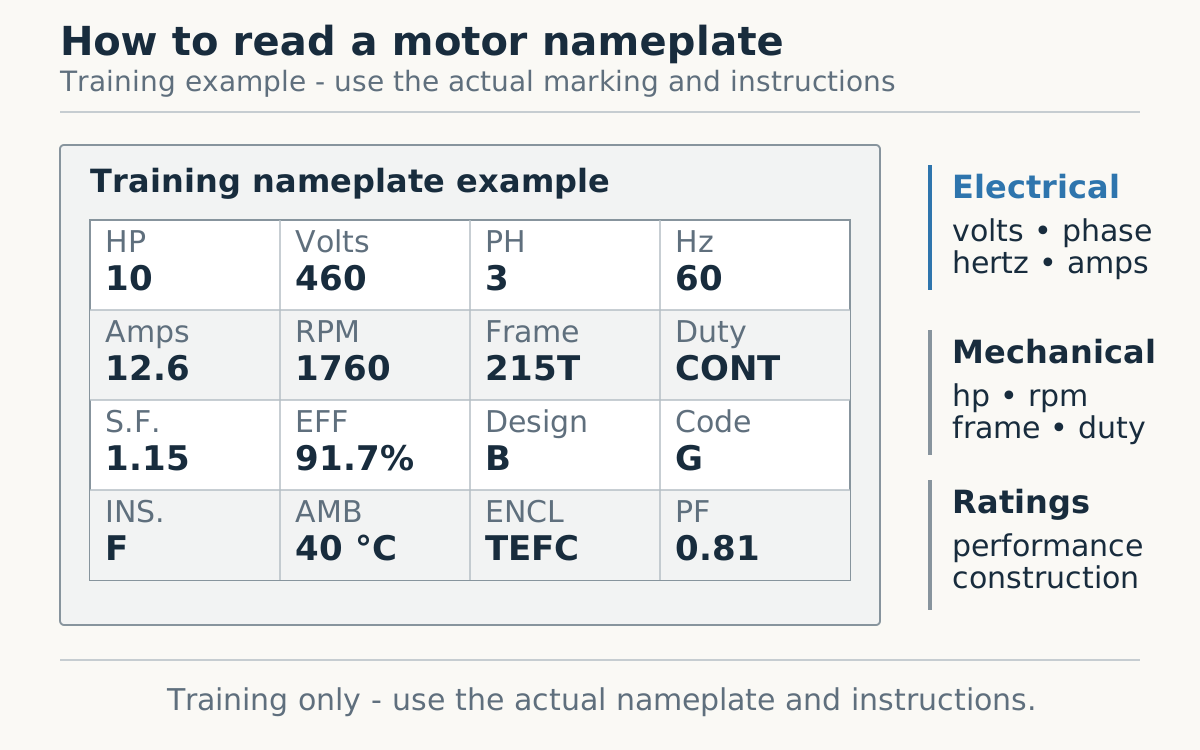
Output, supply, and current
The example is rated 10 hp. Horsepower is mechanical output at the shaft, not electrical input; losses mean input power is higher. It is marked 460 V, three-phase, 60 Hz. Voltage, phase, and frequency must be read together. A voltage match alone does not approve a motor for a different frequency or supply arrangement.
The plate lists 12.6 A full-load amperes (FLA), the rated current at the specified nameplate conditions. FLA is useful for operating comparison and motor overload considerations, but it is not a universal value for every branch-circuit calculation. The distinction from code table current matters enough to handle separately below.
Speed, frame, duty, and service factor
The rated speed is 1760 rpm. A typical induction motor runs below its rotating magnetic field’s synchronous speed while producing torque. Speed is an application rating: replacing a roughly 1760 rpm motor with a roughly 3450 rpm motor can radically change a fan, pump, belt drive, or process even when horsepower seems to match.
Frame 215T communicates standardized dimensional relationships for applicable motors, but suffixes and construction still matter. Verify shaft diameter and length, key, foot holes, mounting face, orientation, conduit-box position, clearances, bearings, and coupling. Never use mounting bolts to force a mismatch into alignment.
CONT identifies continuous duty. The 1.15 service factor describes a defined load capability under the applicable conditions; it is not free continuous capacity for a poor design or a way to normalize overheating. Some plates also show service-factor amperes. That value is not automatically the normal FLA or an overload setting.
Efficiency, power factor, design, and environment
The example shows 91.7% nominal efficiency and 0.81 power factor. Efficiency compares mechanical output with real-power input. Power factor compares real power with apparent power. They are different, so a motor can be efficient while its power factor remains below 1.
NEMA Design B identifies a common general-purpose torque/current/slip characteristic. Code G describes locked-rotor kVA per horsepower and helps characterize starting demand. Neither one is the wiring diagram.
Class F insulation, a 40°C ambient marking, and a TEFC enclosure add thermal and environmental context. “Totally enclosed fan-cooled” does not mean airtight, submersible, washdown-rated, or suitable for every dusty, corrosive, outdoor, or hazardous location. Use exact markings and the application environment.
Do not confuse nameplate FLA with NEC table full-load current
These values can be different because they serve different purposes. The NEC generally uses standardized table full-load current for several ordinary motor branch-circuit conductor and short-circuit/ground-fault protection calculations. It generally uses the actual motor nameplate current as the basis for overload protection. Special motor types and listed equipment can follow other marked values or rules.
Branch short-circuit and ground-fault protection and motor overload protection are also separate functions. The first addresses high fault current in the branch circuit; the second protects the motor from damaging overcurrent and overheating conditions. A branch device that does not open during an overload does not mean the overload protection is optional.
Treat replacement as a system decision
Before approving a replacement, compare four complete groups rather than searching for the same horsepower:
- Electrical: voltage, phase, frequency, hp, FLA, speed, service factor, design, code, efficiency, connection, thermal protection, controller, and variable-frequency-drive compatibility.
- Mechanical: frame, shaft, key, mounting face, feet, orientation, bearings, thrust capability, coupling, belt load, rotation, clearances, and lifting provisions.
- Environment: enclosure, ambient, altitude, dust, moisture, chemicals, washdown, ventilation, and any hazardous-location classification.
- Application: load torque, starting frequency, acceleration time, duty cycle, speed range, braking, backspin, and the consequence of unexpected stopping or starting.
A higher-horsepower motor is not automatically safer. It can change starting current, efficiency at the actual load, controller and protection requirements, and physical fit. Likewise, a motor with matching horsepower, voltage, and frame can still have the wrong speed, enclosure, duty, shaft, or starting characteristic.
Avoid the most common nameplate mistakes
- Treating horsepower as electrical input power or expecting rated rpm to equal synchronous speed.
- Confusing efficiency with power factor, service factor with normal capacity, or design letter with code letter.
- Calling every TEFC motor weatherproof, dust-tight, washdown-ready, or suitable for a hazardous location.
- Assuming an IP rating and a NEMA enclosure designation convert one-for-one.
- Using terminal position or a remembered lead pattern instead of the actual motor’s lead markings and connection diagram.
- Disconnecting conductors before preserving the plate, diagram, lead IDs, rotation, shims, coupling position, and control settings.
Stop when the plate or lead markings are unreadable, the proposed replacement does not match the application, the driven equipment can move or store energy, capacitors may retain charge, the motor can start automatically, or the task exceeds the worker’s qualification and authorization. A careful nameplate reading should reduce uncertainty - not turn incomplete information into permission to experiment.
Official sources and further reading
Use these links to locate current controlling information. Standards, regulations, local adoption, and manufacturer instructions can change.
- U.S. Department of Energy - Motor systemsOfficial DOE resources on motor-system efficiency and performance.
- U.S. Department of Energy - Improving Motor and Drive System PerformanceDOE sourcebook covering motor-system selection, operation, maintenance, and improvement.
- NEMA - Standards and technical resourcesNEMA develops motor performance and marking conventions; use the applicable current standard and manufacturer data.
- NFPA - NFPA 70, National Electrical Code developmentUse the NEC edition adopted for the work; the article does not replace its motor rules.
- 29 CFR 1910.147 - Control of hazardous energyGeneral-industry lockout/tagout requirements; other rules may apply to the specific work.
- 29 CFR 1910.333 - Selection and use of work practicesElectrical safe-work-practice requirements for general industry.